Los Angeles Communities - Name Origins |
 |
|
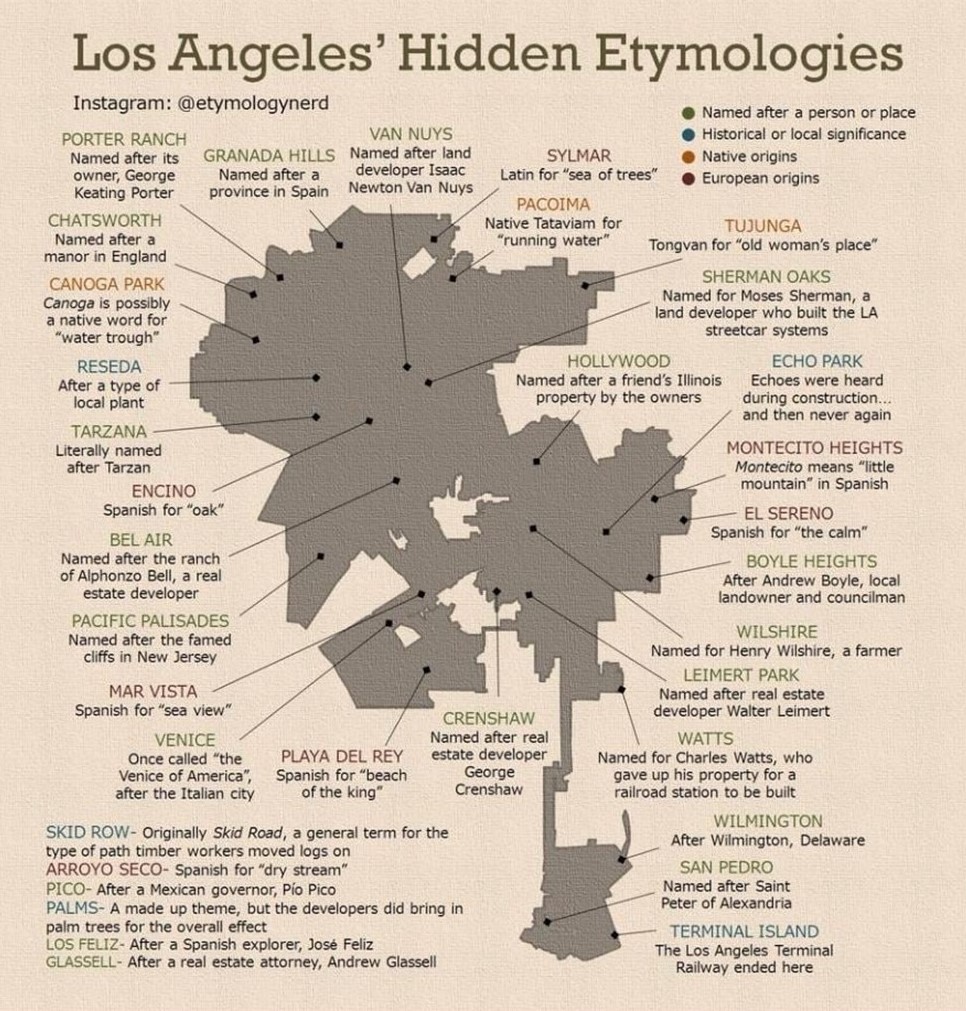
(Map created c. 2016) — The City of Los Angeles encompasses over 100 communities and neighborhoods, often mistaken by residents as separate cities. Each has its own layered history and evolving etymology. The map above highlights the name origins of a selection of communities that together form the diverse fabric of Los Angeles. Source: Instagram (@etymology.nerd), created by Adam Aleksic. For notes on accuracy, interpretation, and omissions, see the explanation below. |
About this map
This map is intended as a visual introduction to the name origins of selected Los Angeles communities, not as a definitive or exhaustive reference. Los Angeles includes well over 100 recognized neighborhoods and districts, and not all could be shown in a single graphic. The explanations presented reflect commonly cited interpretations of place-name origins. In many cases—particularly for Spanish-era and Indigenous names—multiple explanations exist, and meanings have evolved over time through translation, local usage, and later reinterpretation. Some entries are simplified summaries or reflect one interpretation among several. This map was created for popular and educational use, emphasizing clarity and accessibility rather than academic completeness. The omission of certain communities does not reflect their historical importance. Corrections and additional perspectives are welcome. Los Angeles history is layered and complex, and this map should be viewed as a starting point for exploration and discussion, not a final authority. |
Indigenous name usage and interpretation
Some Indigenous place names shown on this map reflect spellings and interpretations that have appeared in historical records and commonly cited sources. Contemporary members of the Tongva community have noted preferred self-identifications such as Tongvet (singular) and Tongvetam (plural), rather than the more widely circulated term Tongvan. As one example, the name Tujunga is often traced to an Indigenous place name historically rendered as Tuxuunga or Tuhuunga, commonly interpreted as “place of the grandmother” or “place of the old woman.” Oral traditions, spellings, and interpretations vary, and meanings are best understood within cultural and historical context. As with many Indigenous place names, variations in spelling and meaning reflect early transcription practices, language loss, and ongoing scholarship. We recognize and respect that contemporary community members may offer more precise or culturally grounded interpretations. |
Additional context on selected community names
Some Los Angeles community names are commonly misunderstood or oversimplified due to overlapping histories, translations between languages, or later development-era naming choices. In these cases, widely repeated explanations may differ from how names were originally applied or understood. For example, Bel Air is often assumed to be named after developer Alphonzo Bell. While Bell developed the area in the 1920s and selected the name, Bel Air is widely understood as a French rendering of Buenos Ayres (“good air” or “fair winds”), referencing the earlier Spanish-era Rancho San José de Buenos Ayres on which the community was developed. The name reflects translation and marketing choices rather than a direct personal namesake. Similar nuances apply to other community names shown on the map, where meanings may involve layered translations, occupational terms, local geography, or later reinterpretation. These examples underscore why the map is presented as an introductory overview rather than a definitive account. |
Additional resources and related name origins
Click HERE to see Community Name Origins - SFV Click HERE to see Street Name Origins - SFV |
* * * * * |
Historical Early Views
Newest Additions
Early LA Buildings and City Views
History of Water and Electricity in Los Angeles
* * * * * |
< Back